PAT Testing Records: Legal Requirements for UK Businesses
Portable Appliance Testing — universally known as PAT testing — is one of the most widely misunderstood areas of electrical safety compliance in the UK. The testing itself is straightforward, but the record-keeping requirements, the question of who must carry it out, and the legal basis for the obligation are frequently misrepresented. This guide cuts through the confusion and explains exactly what UK law requires regarding PAT testing records.
Is PAT Testing a Legal Requirement?
There is no specific law that states portable appliances must be PAT tested. However, several pieces of legislation impose a duty to maintain electrical equipment in a safe condition, and PAT testing is the widely accepted method of demonstrating compliance with these duties.
The Health and Safety at Work Act 1974 requires employers to ensure the health and safety of employees so far as reasonably practicable. The Electricity at Work Regulations 1989 require that electrical systems — including portable electrical equipment — are maintained so as to prevent danger. The Provision and Use of Work Equipment Regulations 1998 require that work equipment is maintained in an efficient state, in efficient working order, and in good repair.
Together, these regulations create a clear legal obligation to maintain portable electrical appliances safely. PAT testing is not the only way to do this — visual inspection, formal maintenance programmes, and other approaches can all contribute to compliance — but it is the most universally recognised method and the one most likely to satisfy HSE inspectors, insurers, and enforcement authorities.
What Records Must Be Kept?
While the law does not prescribe a specific format for PAT testing records, maintaining proper records is essential for two reasons. First, records provide evidence that the duty to maintain equipment safely has been discharged. Second, records allow equipment that is approaching its next test date to be identified and retested before it becomes overdue.
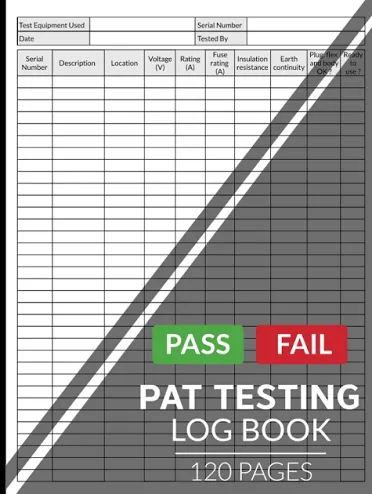
A proper PAT testing record should include the asset identification number or description of the appliance, the location of the appliance, the date of the test, the result — pass or fail — the name and qualifications of the person who carried out the test, the next test due date, and details of any remedial action taken for failed appliances.
Many organisations use dedicated PAT testing software or asset management systems that generate and store records automatically. Paper-based systems are equally acceptable provided records are legible, organised, and accessible.
How Often Should PAT Testing Be Carried Out?
There is no fixed legal interval for PAT testing. The appropriate frequency depends on the type of equipment, the environment in which it is used, and the risk of damage or deterioration. The HSE's guidance suggests a risk-based approach rather than blanket testing at fixed intervals.
Equipment used in high-risk environments — construction sites, catering kitchens, workshops — requires more frequent testing than office equipment in low-risk environments. Equipment that is frequently moved, subject to mechanical stress, or used by multiple operators requires more frequent testing than fixed equipment used by a single operator.
As a general guide, construction site equipment typically requires testing every three months, industrial and workshop equipment annually, and office equipment every one to four years depending on usage patterns. User visual checks before each use complement formal PAT testing and should be part of any electrical safety programme.
Who Can Carry Out PAT Testing?
PAT testing must be carried out by a competent person. For simple low-risk equipment in low-risk environments, a competent person might be someone who has received basic training in the use of PAT testing equipment and understands the relevant safety requirements. For more complex equipment or higher-risk environments, a qualified electrician or electrical engineer is appropriate.
Several organisations offer PAT testing qualifications, including City and Guilds and the IET. For businesses that carry out a significant volume of PAT testing, investing in appropriate training for in-house staff can be cost-effective. For smaller organisations, contracted PAT testing services are widely available.
What Happens to Failed Appliances?
Any appliance that fails a PAT test must be taken out of use immediately. The failure must be recorded, and the appliance must either be repaired and retested or disposed of. It must not be returned to use until it has passed a subsequent test. Failed appliances should be clearly labelled to prevent accidental use.
Records of failed appliances and the action taken are as important as records of passing appliances. An enforcement authority investigating an electrical incident will want to see evidence that failed equipment was properly managed — not just that testing was carried out.
PAT Testing for Landlords
For residential landlords, portable electrical appliances provided as part of a furnished tenancy must be safe. While there is no specific legal requirement for PAT testing of landlord-supplied appliances in the private rented sector in the same way as for fixed wiring, the obligation to provide safe equipment under the Landlord and Tenant Act 1985 and the Consumer Protection Act 1987 effectively requires that appliances are regularly checked and maintained.
For HMOs, local authority licensing conditions typically require portable appliance testing of landlord-supplied equipment. The frequency required varies by local authority but is commonly annual.
Frequently Asked Questions
Do I need to PAT test equipment that employees bring in from home? Yes — if personal equipment is used for work purposes, the employer has a duty to ensure it is safe. This includes personal laptops, phone chargers, and other equipment brought in by employees. A register of approved personal equipment, subject to the same inspection regime as company equipment, is best practice.
How long must PAT testing records be kept? There is no statutory minimum retention period for PAT testing records. Retaining records for at least the life of the equipment, plus a reasonable period, is advisable. In practice, many organisations retain records indefinitely in digital form.
Can I carry out PAT testing myself? Yes, provided you are competent to do so for the type of equipment and environment in question. Competence requires understanding the testing process, the relevant regulations, and the risks involved. For most business owners managing simple office equipment, a recognised PAT testing course provides the necessary competence.
Key Takeaways
- PAT testing is not explicitly required by law but is the accepted method of meeting legal duties to maintain portable electrical equipment safely.
- Records must identify each appliance, record the test date and result, note the tester's details, and specify the next test due date.
- Test frequency should be risk-based — high-risk environments and frequently moved equipment require more frequent testing.
- Failed appliances must be taken out of use immediately, clearly labelled, and either repaired and retested or disposed of.
- Testing must be carried out by a competent person — qualifications and experience appropriate to the equipment and environment.
- Records of failed appliances and remedial action are as important as records of passing tests.