Service History Stamps: How to Spot Fakes and Verify Authenticity
How to spot fake service history stamps on UK used cars, 5 detection methods that catch most forgeries before you pay.
 By Jamie Dawson · Editor
▮
Updated 14 Sep 2026
▮
5 min read
By Jamie Dawson · Editor
▮
Updated 14 Sep 2026
▮
5 min read
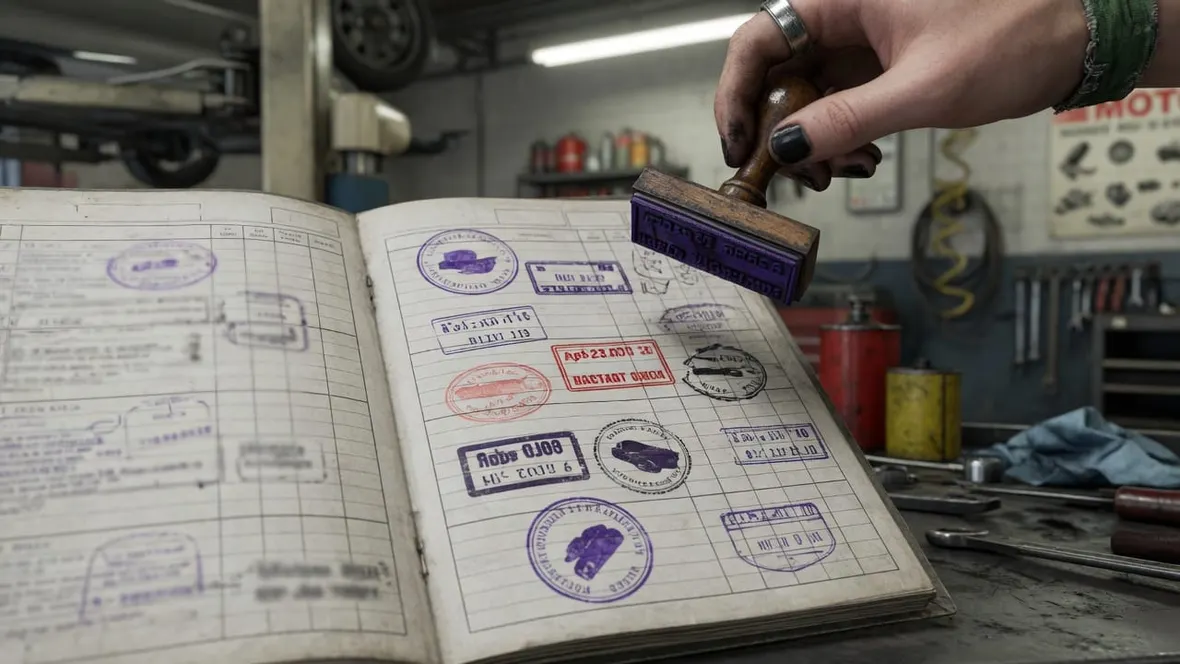
Quick answer: Fake service history stamps appear on roughly 5-12% of UK used cars with claimed full service history, and the rate is higher on premium brands where the value uplift justifies the fraud. Five detection methods catch most: handwriting and ink consistency analysis, verifying each named garage exists in Companies House and Google Maps, cross-referencing stamp mileage against MOT history at gov.uk, calling each garage to confirm the work, and demanding invoices for the last three services. The combined process takes 30-60 minutes and saves the average buyer £1,500-£3,000 in over-payment risk.
The service stamp is the cheapest fraud in the UK used-car trade. Anyone with £20 and an internet connection can have a stamp made in 24 hours that looks identical to a legitimate garage's. The fraud only fails when buyers do the verification work, and most buyers don't. This is what genuine verification looks like.
Method 1: Handwriting and ink analysis
Open the service book and look at every stamp on the same page or facing pages. In a real service book:
- Different garages will have different handwriting (each garage's service advisor or workshop manager writes their own)
- Ink colour will vary subtly between visits (different pens, ink batches over years)
- Stamps from different garages will be at different positions on the page (no consistent layout)
- Date formats may vary (DD/MM/YY vs DD/MM/YYYY vs Month abbreviation)
Fabricated service histories often show the opposite, same handwriting, same ink, identical layout, identical date format. One stamp made by one person, applied to multiple "different" garages.
Method 2: Verify each garage exists
For each garage in the service book:
- Search the garage name and town on Google Maps. Real garages have addresses, opening hours, reviews, photos.
- Check Companies House for the trading name. Real businesses register; ghosts don't.
- Look for a website. Most legitimate UK garages now have at least a basic website.
- Check trade body membership, RMI, Bosch Car Service, Trust My Garage, IMI, manufacturer-approved networks.
A garage stamp with no verifiable existence is a strong signal of fabrication. A garage that has closed since the service is ambiguous, note it but don't conclude.
Method 3: MOT mileage cross-reference
This is the single most-powerful technique. Pull the full MOT history at gov.uk/check-mot-history.
For each service stamp, check the date and stated mileage against MOT records:
- Service mileage should be consistent with MOT progression (between MOT readings)
- No service stamp should show higher mileage than a later MOT
- No service stamp should show lower mileage than an earlier MOT
- Mileage progression between services should be roughly linear
Mismatches here are the strongest single fraud indicator. They also catch clocking, stamps fabricated on a clocked car often show inconsistent mileage.
Method 4: Call each garage
For the most-recent three services, call the garage and ask:
- "Do you have a record of servicing [VRM] on [date]?"
- "Can you confirm the mileage at that service?"
- "Could you email me a copy of the original invoice?"
UK garages are required to retain VAT invoices for 6 years. For services within that window, they should be able to confirm or deny.
Genuine garages will check their system in real-time. Fabricated services will be denied. Garages that refuse to verify or want fees to look up old records are ambiguous, make of that what you will.
Method 5: Demand invoices
Stamps without supporting invoices are halfway to fabrication. Real services produce paper trails:
- VAT invoice with the garage's name, address, and VAT number
- Date of service
- Vehicle registration and mileage
- Customer name (matching V5C keeper)
- Itemised parts and labour
- Total cost and payment method
For any car over £10,000, demand invoices for at least the last three services. Sellers who "don't keep paperwork" on premium cars are flagged as risky.
Method 6 (premium cars only): Manufacturer DSR
For cars from BMW, Mercedes, Audi/VW group, Porsche, Volvo, Tesla, Jaguar Land Rover, ask for the manufacturer Digital Service Record. Two ways:
- Seller takes the car to a main dealer for an official printout (some free, some £15-£25)
- Seller logs into their manufacturer account and provides screenshot or printout
DSR is materially harder to fake than paper stamps. It requires manufacturer dealer system access. A fully-DSR car with the printout matching the paper service book is the highest-confidence verification.
What fakes typically look like
- Generic stamps: "Authorised Service Centre" with no specific garage name
- Recent dates only: fabrications often only cover the last 2-3 services to make a "recent" history
- Round-number mileage: every service at exactly 10,000 mile intervals is statistically unlikely
- Identical mileage spacing: real services aren't always at the manufacturer-recommended interval; missed services and longer gaps are normal
- Stamps from chains that don't service this brand: Halfords or Kwik Fit on a brand-new BMW M-car raises questions
- Stamps with no advisor signature: most main dealer stamps include the service advisor's signature
What real service books look like
- Pre-delivery inspection by the supplying dealer at zero or near-zero miles
- First service at manufacturer-recommended interval (often 10k or 12 months)
- Consistent stamps from the same dealer or specialist for the warranty period
- Possibly a switch to independent specialists after warranty expiry, main dealer stamps gradually replaced by branded independent stamps
- Notes about advisories or major work alongside stamps
- Variability in handwriting, ink, position
- Aged paper and ink (subtle yellowing on older stamps)
Common scenarios
Scenario A: Stamps look great, garage confirms work
Genuine. Proceed at standard price.
Scenario B: Stamps look great, mileage matches MOT, but no invoices
Probably genuine, weak evidence. Proceed at slight discount or accept as standard.
Scenario C: Stamps look fine but one garage doesn't exist
Yellow flag. Could be a closed business, but worth pushing for invoice for that specific service.
Scenario D: Mileage at stamp inconsistent with MOT
Walk away. Either fabricated stamps or clocking. Both are deal-breakers.
Scenario E: Stamps from one garage repeated across "different" garages (same handwriting/ink)
Walk away. The whole history is fabricated.
FAQs
What if the seller has lost the service book?
Treat as no service history. The seller can rebuild from invoices and DSR if they had services done at traceable garages, push them to do this rather than accepting the loss.
Are stamp-only books worth less than invoice-supported books?
Yes, materially. Industry trade buyers value full-history-with-invoices about 5-15% above stamp-only-history, all else equal.
Can I check stamps myself or do I need a specialist?
For most cars, the 30-60 minute DIY process catches most fakes. For high-value classics, marque specialist verification adds confidence and is worth the £100-£300 cost.
What's the legal recourse if I bought a car with fake stamps?
Misrepresentation under the Consumer Rights Act 2015 (or Misrepresentation Act 1967 for private sales). Recovery is typically a price adjustment or full sale reversal. Trading Standards may also pursue criminal action against the seller.
Related guides
- How to verify a car's service history
- Full vs partial service history: UK buyer's guide
- Used car mileage verification: spotting a clocked car
- The 7 documents to check when buying a used car
- Jaguar Service History: Free VIN Check, No Login (UK)
Related guides
Before you trust the paperwork, check the car's MOT history
Every MOT result, mileage reading and advisory since 2005, straight from DVSA records. Free, no sign-up.
Run the free MOT history check →Sources
- gov.uk: Check MOT history
- HMRC: VAT record-keeping requirements for businesses
- Society of Motor Manufacturers and Traders (SMMT)
Last reviewed 2026-05-05 by Jamie Dawson, Editor.
Cross-check the stamps: our free MOT history check gives you the recorded mileage at each test, which should line up with the mileages written in the service book.