What Is a COSHH Register? UK Employer Guide (with Template)
A COSHH register is the master list of every hazardous substance in a UK workplace. Each entry links to a Safety Data Sheet and a written risk assessment. Required for COSHH 2002 compliance.
 By Jamie Dawson · Editor
▮
Updated 17 Aug 2026
▮
3 min read
By Jamie Dawson · Editor
▮
Updated 17 Aug 2026
▮
3 min read
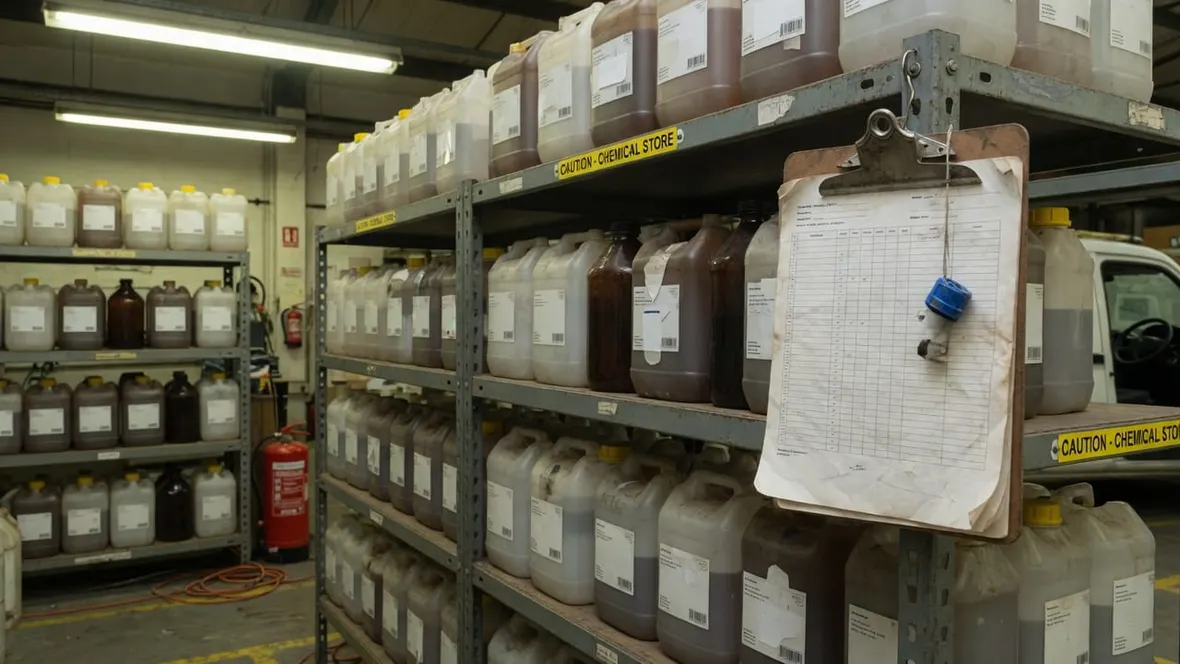
Quick answer: A COSHH register is a central list of every hazardous substance used or stored in a UK workplace. Each entry links to the Safety Data Sheet (SDS) supplied by the manufacturer and a written COSHH risk assessment completed by the employer. It's the document HSE inspectors ask for first when assessing COSHH 2002 compliance. Without one, an employer cannot demonstrate that they've identified, assessed, and controlled every hazardous substance, the foundation duty under the Regulations.
What a COSHH register actually is
A COSHH register is a single, accessible document (paper or digital) that lists every hazardous substance present in your workplace, with details for each. It's the master index that connects:
- Products you use (cleaners, solvents, paints, oils, etc.)
- Safety Data Sheets from suppliers
- Risk assessments you've completed
- Control measures (PPE, ventilation, training)
- Named users authorised to handle each substance
What goes in each register entry
| Field | What to record |
|---|---|
| Product name | As shown on the product label |
| Supplier | Manufacturer or distributor |
| Date added to register | When the product entered your workplace |
| Hazard classification | From the SDS, corrosive, toxic, sensitiser, etc. |
| Pictograms | CLP hazard pictograms on the label |
| Locations used | Which rooms, processes, or operations |
| SDS reference | Section 1.1 product identifier; date of SDS |
| Risk assessment reference | Internal reference number for the written assessment |
| Risk assessment date | Date completed; review date |
| PPE required | Gloves, goggles, respirator, etc. |
| Storage requirements | Where and how to store safely |
| Disposal route | How to dispose; special waste rules |
| Trained users | Names of staff trained on this substance |
| Last review date | For annual or process-triggered reviews |
Why HSE expects a COSHH register
The COSHH Regulations 2002 require employers to:
- Assess risks from hazardous substances
- Decide what precautions are needed
- Prevent or adequately control exposure
- Ensure controls are used and maintained
- Monitor exposure where appropriate
- Carry out health surveillance where appropriate
- Prepare plans for accidents/emergencies
- Train, inform, instruct staff
Steps 1-3 are impossible to evidence without a COSHH register. When HSE arrives, they ask "show me your COSHH register", and the response determines the trajectory of the inspection.
Common register categories
Most UK workplaces have hazardous substances across these categories:
- Cleaning products: bleach, descaler, disinfectants, drain unblocker
- Solvents and degreasers: IPA, white spirit, brake cleaner
- Paints, inks, adhesives
- Oils and lubricants
- Process chemicals: industry-specific (printing, manufacturing, lab)
- Maintenance chemicals: anti-rust, anti-freeze, RTV silicone
- Dust generated by processes: silica, wood dust, lead
- Fumes generated by processes: welding, hot work, vehicle exhaust
Paper vs digital register
Both are acceptable to HSE. Digital advantages:
- Searchable across substance name, supplier, hazard
- Automatic review-date reminders
- SDS PDFs linked directly
- Cloud backup; multiple-site access
- Audit trails of who edited what
Paper advantages:
- Always accessible during power outages
- Lower implementation cost for small operations
- Annotations easier for some staff
What HSE inspections actually look for
At the inspection, HSE will:
- Ask to see the COSHH register
- Pick one or two substances at random and ask to see the matching SDS and risk assessment
- Ask to see training records for the staff using those substances
- Walk the workplace looking for unlabelled or decanted containers without matching register entries
- Ask to see disposal records and any incident logs
Building a register from scratch
- Walk the workplace. Note every product, decanted container, drum, bottle.
- Request SDS from each supplier (they're legally obliged to provide).
- For each substance, determine if it's hazardous (Section 2 of SDS).
- If hazardous, add to register. If not, note as 'considered, not COSHH-relevant'.
- Write a risk assessment for each, or each process where it's used.
- Cross-reference and check all entries are complete.
- Train staff on what's in the register and how to use it.
Annual review
Every 12 months:
- Confirm each substance is still in use
- Remove decommissioned products
- Request updated SDS from suppliers (typically refreshed every 1-3 years)
- Review and date each risk assessment
- Update training records
- Document the review
Common register failures
- Decanted spray bottles not in the register
- SDS over 5 years old
- Substances on register with no matching risk assessment
- Risk assessments dated 2018, never reviewed
- No named user training records
- Cleaning products treated as "not COSHH" when most are hazardous
Related guides
- COSHH assessment records: UK employer duties
- COSHH for cleaning products: employer duties
- Site accident book: legal requirements
- Work at Height Regulations record-keeping
- Duty of care waste records: what UK businesses must keep
Last reviewed 2026-05-19 by Jamie Dawson, Editor.