Work at Height Regulations: Record Keeping Requirements UK
What UK employers must record under the Work at Height Regulations 2005, risk assessments, equipment inspections, and training logs.
 By Jamie Dawson · Editor
▮
Updated 08 Sep 2026
▮
4 min read
By Jamie Dawson · Editor
▮
Updated 08 Sep 2026
▮
4 min read
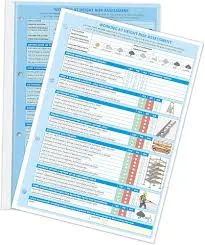
Falls from height remain the single largest cause of fatal workplace injuries in the UK. The Work at Height Regulations 2005 impose comprehensive duties on employers, the self-employed, and those who control work at height activities, and a significant part of those duties involves maintaining proper records. This guide explains exactly what records the Work at Height Regulations require, who must keep them, and what inspectors look for.
What the Work at Height Regulations 2005 Require
The Work at Height Regulations 2005 apply to all work at height where there is a risk of a fall liable to cause personal injury. They impose duties on employers and the self-employed to ensure work at height is properly planned, supervised, and carried out by competent persons. Equipment used for work at height must be suitable, maintained, and inspected, and those inspections must be recorded.
The regulations do not create a single unified logbook requirement. Instead, record-keeping obligations arise from several specific provisions within the regulations, each applying to different types of equipment and activity.
Inspection Records for Work Equipment
Schedule 7 of the Work at Height Regulations requires that certain work equipment used at height is inspected at specified intervals and that inspection records are maintained. The equipment covered includes scaffolding, mobile work platforms, mast climbing work platforms, and any other working platforms from which a person could fall two metres or more.
The inspection record must include the name and address of the person for whom the inspection was carried out, the location of the workplace inspected, a description of the work equipment inspected, the date and time of the inspection, details of any matter identified that could give rise to a risk to health or safety, details of any action taken, details of any further action considered necessary, and the name and position of the person making the report.
The report must be completed before the end of the working period in which the inspection is carried out. It cannot be backdated.
Inspection Frequencies
The required inspection frequency depends on the type of equipment and the circumstances of use. Scaffolding must be inspected before first use, after any event likely to have affected its stability, and at intervals not exceeding seven days. Mobile elevated work platforms must be inspected before first use on site and at regular intervals thereafter in accordance with the manufacturer's instructions and the PUWER regulations. Ladders and stepladders used in the workplace should be pre-use checked by the user before each use, with more formal periodic inspections recorded at appropriate intervals.
Competence Records
The Work at Height Regulations require that work at height is carried out only by persons who are competent to do so, or if being trained, who are supervised by a competent person. Competence records, training certificates, PASMA cards for mobile access towers, IPAF licences for mobile elevated work platforms, and similar qualifications, must be maintained and available for inspection.
Copies of relevant certificates should be held on site and checked before operatives begin work at height. The site manager or supervisor should maintain a register of operatives authorised to carry out work at height and their relevant qualifications.
Risk Assessment Records
Under the Management of Health and Safety at Work Regulations 1999, employers with five or more employees must record their significant risk assessments in writing. For work at height, this means maintaining written records of the risk assessments carried out before any work at height activity commences.
The risk assessment record should identify the work activity, the hazards, the persons at risk, the existing controls, any additional controls required, and the residual risk rating. It should be reviewed whenever the work activity changes, after any incident, and at regular intervals.
Method Statements and Permits to Work
For higher-risk work at height, fragile roofs, work near unprotected edges, work over water or hazardous substances, a method statement describing how the work will be carried out safely is required. Permits to work may also be required where the risk warrants a formal authorisation process. Both documents must be retained as part of the site records.
How Long Must Records Be Kept?
Schedule 7 of the Work at Height Regulations specifies that inspection reports must be kept until the next inspection report for the same equipment is made or, if the equipment is used on a construction site, until the end of the project. In practice, retaining all work at height inspection records for a minimum of three years after the work is completed is strongly advisable, personal injury claims arising from falls can be brought years after the incident.
Frequently Asked Questions
Do the Work at Height Regulations apply to work on domestic premises?
Yes. The regulations apply to any work at height, including work carried out by contractors on domestic properties. Homeowners who employ contractors to carry out work at height are not personally subject to the regulations, but the contractor is.
Does a ladder inspection need to be formally recorded?
For ladders used in the workplace, a pre-use check by the user is required before each use. This does not need to be formally recorded in writing for every use, but a periodic formal inspection (typically annual) should be recorded. Where ladders are provided to workers and used regularly, a ladder register with inspection records is best practice.
What qualifications are required for work at height inspections?
Competence for work at height inspections is defined by the type of equipment being inspected. For scaffolding, a qualified scaffolding supervisor with CISRS qualifications is typically required. For MEWPs, an IPAF-trained operator can carry out pre-use checks. For more complex assessments, a competent engineer may be required.
Key Takeaways
- The Work at Height Regulations 2005 require inspection records for scaffolding, mobile work platforms, and other working platforms from which a person could fall two metres or more.
- Inspection reports must be completed before the end of the working period. They cannot be backdated.
- Records must include specific statutory information including the inspector's details, the equipment description, the date, and any defects identified.
- Competence records for all operatives carrying out work at height must be maintained and available for inspection.
- Risk assessments for work at height must be recorded in writing where five or more persons are employed.
- Inspection records must be kept until the next inspection or until the end of the project, retaining them for at least three years is best practice.
Related guides
- Excavation Inspection Records: UK Legal Requirements
- Scaffold Inspection Logbooks: UK Legal Requirements
Free download: for lifting equipment and accessories, our LOLER thorough examination register tracks each item against its correct regulation 9 interval.