Will Property Logbooks Succeed Where Home Information Packs (HIPs) Failed?
Home Information Packs (2007-2010) tried to move property information upfront and failed. Will the 2026 digital property logbooks succeed? What's different this time.
 By Jamie Dawson · Editor
▮
Updated 26 Sep 2026
▮
5 min read
By Jamie Dawson · Editor
▮
Updated 26 Sep 2026
▮
5 min read
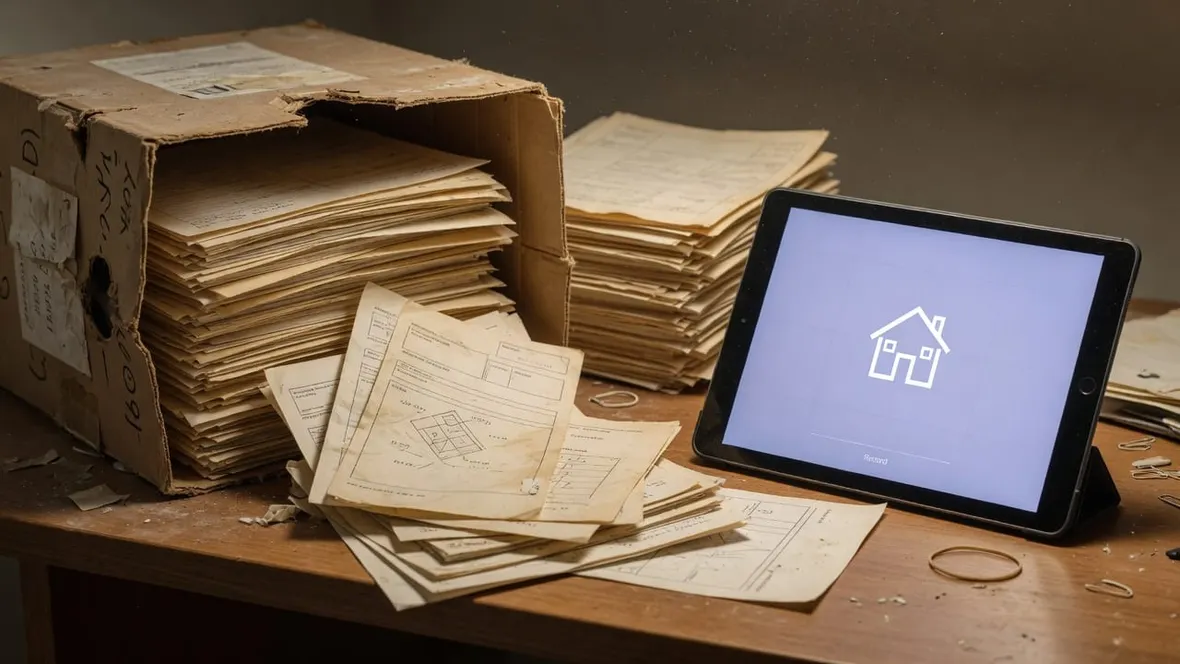
In short: We have been here before. Home Information Packs (HIPs) were introduced in England and Wales in 2007 to move key information upfront, and scrapped in 2010. The 2026 property logbook and sales-pack reforms share that goal, so the obvious question is: will they succeed where HIPs failed? The short answer: they have a better chance, because they are digital-first, homeowner-owned and built on data standards that mostly already exist, but the same fault lines (cost and who pays) remain.
Prefer to watch? 40 seconds, from our YouTube channel.
What were Home Information Packs?
HIPs were rolled out from 2007 and, by the end of that year, required for virtually all homes on the market in England and Wales. A seller had to provide a pack before marketing, containing searches, evidence of title and an Energy Performance Certificate. The headline feature, a Home Condition Report, was made voluntary before launch, which hollowed out much of the value.
Why did HIPs fail?
- Cost, and who paid it. Sellers resented paying several hundred pounds upfront, especially in an uncertain market.
- The Home Condition Report was dropped. Without an independent condition report, buyers still commissioned their own surveys, so the pack duplicated cost rather than removing it.
- Bad timing. HIPs landed just as the 2008 financial crisis froze the housing market.
- Industry opposition and a change of government, the incoming coalition suspended HIPs in 2010.
One thing survived: the EPC, which outlived HIPs and is still required today.
How the 2026 reforms differ
The new home buying and selling reforms are not simply “HIPs 2.0”:
- Digital, not paper. A digital property logbook is owned by the homeowner and reused at every future sale, rather than a static pack regenerated each time.
- Data sharing built in. Information flows securely between professionals and is verified at source, cutting the back-and-forth.
- The groundwork already exists. Material-information disclosure is already mandatory, the BASPI dataset is in use, and Scotland’s Home Report has proven the model for over 15 years.
The unresolved question
The fault line that sank HIPs, who pays, and is the upfront cost worth it?, has not gone away. The reforms bet that digital reuse and faster, more certain sales will justify the cost. Whether sellers agree is the test. Follow the reform tracker for how it unfolds.
Sources
gov.ukHome Buying and Selling Reform roadmap (2026)
HIPs vs the 2026 reforms: side by side
The differences matter more than the similarities. Here is the honest comparison:
| HIPs (2007 to 2010) | Logbooks & sales packs (2026 onwards) | |
|---|---|---|
| Format | Paper pack, assembled per sale | Digital record, maintained over the property's life |
| Who owns it | Nobody, really, commissioned for the transaction, then binned | The homeowner; it transfers with the property |
| Condition information | Home Condition Report made voluntary before launch. The pack's core value was hollowed out on day one | Condition is in scope for sales packs, phased in with industry consultation rather than dropped |
| Data infrastructure | None, PDFs and paper | Core Logbook Specification (agreed with government in 2020), National Register of Logbooks, HM Land Registry proof-of-concept |
| Rollout | Big-bang mandate, then immediate backlash | Phased: voluntary guidance (2026) → Code of Practice → consultation → legislation (2027 to 2028) |
| Reusability | Pack expired if the sale fell through, pure sunk cost | The logbook persists; a failed sale doesn't destroy the asset |
| Political timing | Launched into the 2008 crash | Launched into a market where digital ID, e-signatures and open data already exist |
Who pays this time? The question that killed HIPs
HIPs died on a simple economic objection: sellers paid £300 to £600 upfront for a pack buyers didn't trust and surveyors didn't replace. Any honest assessment of the 2026 reforms has to answer the same question.
The emerging answer is structurally different. A digital logbook's cost is spread over years of ownership rather than dumped at the point of sale, and many providers offer free basic tiers, monetising transaction services instead. The sales pack is then an extract from data the owner already holds, not a bespoke document assembled from scratch under time pressure. Whether that holds in practice depends on how much verification (searches, condition information) the final legislation requires at listing. That is the line to watch in the 2027 to 28 consultation.
What would make logbooks fail anyway
- Upfront cost creeping back. If the sales pack ends up requiring paid searches at listing, the HIP objection returns intact.
- A change of government or priorities. HIPs were abolished within weeks of the 2010 election. Reform by non-statutory guidance is fast, but reversible; only legislation locks it in.
- Provider fragmentation. If logbooks don't interoperate in practice (whatever the specification says) conveyancers will ignore them, and the whole data layer collapses back into PDFs.
- The portals sitting it out. If Rightmove and Zoopla don't surface logbook/sales-pack status on listings, sellers have no visible incentive to prepare one.
The five signals to watch
- The voluntary sales-pack information list due in 2026, modest and achievable, or search-heavy and expensive?
- The Land Registry proof-of-concept results. If title data flows into logbooks smoothly, verification stops being theoretical
- Portal behaviour, any move to display upfront-information status on listings
- Conveyancer adoption, the profession killed HIPs by ignoring them; watch whether case-management systems integrate logbook data
- The consultation response in 2027 to 28, especially on who bears cost at listing
We track all five, every milestone gets same-week coverage, and the reform timeline is updated as dates firm up.
Frequently asked questions
What was a Home Information Pack?
A mandatory pack of upfront information (searches, evidence of title, and an Energy Performance Certificate) that sellers in England and Wales had to provide before marketing a home, required from 2007 and suspended in May 2010.
Why were HIPs scrapped?
A combination of upfront cost to sellers (£300 to £600), the voluntary Home Condition Report gutting the pack's value, duplication with buyers' own surveys, the 2008 market crash, and a change of government in 2010.
Are property logbooks just HIPs again?
They share the goal (information upfront) but not the mechanism. HIPs were disposable paper packs assembled per sale; logbooks are persistent digital records owned by the homeowner, built on an agreed data standard, with a phased voluntary-first rollout.
Did anything survive from HIPs?
Yes, the Energy Performance Certificate. EPCs were introduced as part of HIPs and remain mandatory today, which is a useful reminder that parts of a failed reform can become permanent infrastructure.
The UK Property Logbook series
- Start here: Property logbooks: the complete guide · What goes in a property logbook? · Digital logbooks explained
- The 2026 reform: Home buying & selling reform · Reform timeline · Sales packs · Property passports
- Buying & selling: Conveyancing documents checklist · Material information: Parts A, B, C · Logbooks and house sales · England, Scotland, Wales & NI
- Landlords & leasehold: Property logbook for landlords · The PRS Database: what landlords must register · Leasehold documents · New-build handover documents
- Providers & costs: How to choose a provider · The RLBA provider landscape · What a logbook costs
- Free tools: Sales Pack Readiness Checker · Landlord Compliance Calendar · Your Home’s Public Record checker
Related: Are HIPs coming back? The 2026 rules, explained.
Binding contracts and the HIPs lesson
Forcing commitment without trusted upfront data would reverse the HIPs lesson. See how the roadmap sequences packs before binding conditional contracts.